The definition of insanity.

Albert Einstein is attributed as defining insanity as: “doing the same thing over and over again and expecting different results”. Over these last two international matches we have watched Scotland loose to Russia and be dismantled by world number one’s Belgium.

In the cold light of day losing to Russia, ranked 46th by Fifa (as of 25 July 2019), the same team who reached the quarter finals of the 2018 World Cup losing a penalty shoot out to finalists Croatia, maybe didn’t come as to much of a shock.  The manner of the defeat is what upset most. The game management (decision making) was poor, belief was lacking and we lacked composure.  And Belgium, a country of about 11.5Million people?  Well they can spank any nation.

So what do we do next?  Sack the manager? Blame *insert team name(s)* for not giving Scottish kids a chance? Big TV for not sharing Big money? England??  See above quote from our German-born physicist.

If we want to see something different from our national team we need to do something radically different with the format of our game.  If our eggs are being placed in the basket of “Project Brave”, lets fund it fully so all eligible clubs can achieve the measurable performance outcomes (or MPOs). 

Let’s focus on eligibility for a moment.  Belgium, Fifa number 1 ranked team, have a population if 11.5M and a league structure of 24 pro teams.  Sure, they have relegation between Amateur and Professional, but its 24 pro teams. Why are we still trying to have “top leagues” of 42 teams (excluding those in rungs 5-7, junior and amateur football).  Previously, I’ve written about restructuring Scotland’s league setup into a regional structure, similar to that seen in American NFL (East and West or North and South).  I still believe it will generate more fan interest in the game with less travel and more “local” games (see Greenock Morton’s recent Friday night trip to Inverness for TV, a shocker of a 400 mile round trip). Maybe the path forward is a blend of regional and top leagues. 16, 12 and 12?  And if you want to be one of the 40 “pro” teams then you must be funded to and comply with the MPOs of project Brave. If you choose not to be part of this setup, then you can’t enter the top leagues. A tough stance, but if we want to make radical changes we need to make radical choices.

Focusing back on the youth setup, is it time we took a more radical approach here as well?  Assuming all that’s gone before in this blog happens (regional leagues, draft picks, summer league for under 23 Scottish players etc), then what else can we do?  Well one thing we may want to implement is a Postal Code restriction system, forcing teams to invest in “local” youth development, doing more for the “local” community.  Outside some of the big clubs in Scotland, this may be music to the ears of some “smaller” teams with kids from all over Scotland being attracted to the “bright lights” of the big clubs, only to be lost in the forest of kids, both national and international, at these teams. As a final measure why not block or restrict the non-national (unable to play for Scotland) that any team in Scotland can invest in at youth level.  Maybe a tougher conversation whist we are part of Europe, or maybe not if Brexit happens.  Shockingly though I believe they will sort Brexit out before we make any real change in our approach to Football in this country.

So here is an alternative proposal for Scottish Football:

  • Inclusion:  As part of our product, and the distribution of wealth, lets embrace the growing interest in Women’s football and include it as part of our TV deals
  • Regionalisation:  Ensuring interest in a 40 league product is difficult. Increasing the top division to 16 introduces more match diversity, something top league supporters have been crying out for. Under this we regionalize into 2 leagues with the winner of each playing in a final “playoff” game to achieve promotion to the top division (super bowl style 1 off winner with 1 up and 1 down)
  • Youth: Lets embrace “project brave” and fund all clubs, who want to be part of our professional league setup, with the money the need to achieve the MPOs.  Let’s lock our clubs into development “areas” (either postal or regional areas), and let’s force our clubs to develop our national youth be restricting or blocking the development of non-national (not eligible to play for Scotland) youth.
  • Draft: Let’s force a draft of our young Scottish talent.  Whilst many top clubs are investing in youth, most coaches will tell you that actual competitive game time is one of the best ways to develop as a young player.  Introduce a summer sprint league for our top league youth teams and lets force playing of at least 4 under 23 Scottish players in each of the regional team line-ups. That’s 96 Scottish under 23s playing every week in competitive games.
  • Style: Let’s shake up the points system outside the top league.  Rugby has introduced a change in the points system to encourage a more attacking style of play.  We will do the same in the regional leagues to encourage a more entertaining style of play which will make the product more attractive and bring fans back to the games

Interested in more?  Read it at my previous blog post.
A radical plan for Scottish football

1998. That was the last time the Scottish men’s national football team qualified for a major tournament. Birth rates leading up to and since the 1998 World cup have dropped significantly in Scotland. From 94,768 in 1968 to 51,311 in 2018. A 45% drop, likely driven by social and economic circumstances. We have seen the dawn of BIG TV football money into the game with the rich getting richer and the poor getting poorer. We have little money in our game, fans have little money in their pockets and we have is less people in the country. Will we ever see our men’s team at a national tournament again?

Nothing we change within the game differentiates our product. We can’t make it more attractive to investors which makes it less attractive to players and managers. We are being locked out of European competition as the big boys circle the wagons around the revenue. Our efforts to change and improve the game have been constrained by those who can only see increasing or decreasing league numbers as the path to success. Maybe it’s time for something different, maybe it’s time to be radical

The change

Let’s look to other sports to introduce something really different that will get people excited about the product, bring them back to the grounds and differentiates us from the rest, making it more attractive to investors.

  • Inclusion: As part of our product, and the distribution of wealth, lets embrace the growing interest in Women’s football and include it as part of our TV deals
  • Regionalisation: Ensuring interest in a 40 league product is difficult. Increasing the top division to 16 introduces more match diversity, something top league supporters have been crying out for. Under this we regionalize the remaining teams into 2 leagues with the winner of each playing in a final “playoff” game to achieve promotion to the top division (super bowl style 1 off winner with 1 up and 1 down)
  • Draft: Let’s force a draft of our young Scottish talent. Whilst many top clubs are investing in youth, most coaches tell you that actual competitive game time is one of the best ways to develop young players. As part of our product we would introduce a summer sprint league for our top league youth teams, brining an additional element to our product that would attract broadcasters. This summer youth league also acts as the scouting ground for regional league teams to view potential draft picks for the upcoming season.
  • Style: Let’s shake up the points system outside the top league. Rugby has introduced a change in the points system to encourage a more attacking style of play. We will do the same in the regional leagues to encourage a more entertaining style of play which will make the product more attractive and bring fans back to the games

The top league

Scotland will have one top league consisting of 16 teams playing 30 games a season. Each team must contain a roster of at least 16 professional players ensuring that the club remains professional. One team is automatically relegated.  All other existing SPFL rules would remain in place.

The pyramid

Under the top league would be 2 divisions of 12 teams (24 in total), East and West (or North and South) regional leagues, playing 44 games in total.  These teams compete to finish at the top of each league.  The winners of each league would then play off in a final to earn the right to be promoted to the top division.  (other options could be explored here to expand promotion and relegation between the top division and regional leagues)

In the regional leagues we would change the point system to reflect that of rugby union. This point system was brought in to encourage more attacking game. Exactly what people want to see from football

  • 4 points for a win
  • 2 points for a draw
  • 1 bonus point for scoring 3 or more goals regardless of the result
  • 1 bonus point for a clean sheet
  • 0 points for a loss

Winning teams would score between 4 and 6.  Teams that draw would score between 2 and 3 and losing teams would score between 0 and 1 points.

Promotion to the top division will require that teams comply with the existing rules, such as stadia needs, as well as the youth academy requirements.

The draft

The flagship change. Our summer sprint leagues allow our youth players competitive action. It also allows us to sell a potential 12 month TV product. To achieve this each team in the top league must have a youth academy which retains FIFA/UEFA qualified coaches. These academies will play in a summer sprint league (16 games (Saturday, Sunday/ Wednesday, Thursday for 8 weeks) with players up to the registered age of 23. Ahead of the new season, teams in the top division can name up to 6 youth players (U23) to retain with the top team. All other youth players, who are eligible to play for the Scotland national team, and are 17 and over, then enter a draft. Stats for the draft are captured through the summer sprint league and presented ahead of the draft weekend. Parent clubs would retain wages for these players as they return each season

Teams within the pyramid can select up to 4 players from this draft to complete their squads. (meaning 96 picks) Similar to the NFL, the order of selection is determined by the previous seasons finishing places with the last place team picking first. At least 4 under 23, home grown players, must play each week for a conference team.

In order to achieve this number of draft picks, each premier league, team must have at least 12 over 17 registered U23 players. 6 for draft selection and 6 that can be registered with the professional team.

Relegation

Relegation from the top division will be into either conference. This will allow the league authority to re-set each regional league each year, bringing a level of variation to the game.

Revenue generation

This paper is not focused on revenue generation, more the development of Scottish football talent and proposing a radical change that differentiates our product.  However, broadest money would be a big factor in the success of this, or any, setup.  As such a suggestion is shown below.

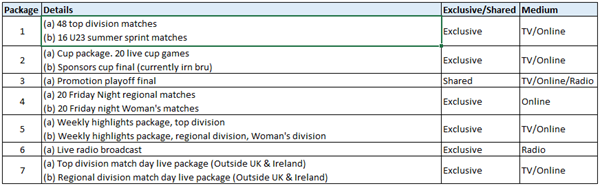
All digital broadcast content (TV, radio and online) as well is league sponsorships, is controlled and auctioned centrally as a “single” package. Brining online broadcasting into a central auction will ensure that the future of revenue generation (online broadcasting) is accounted for.  In addition, this makes the entire product more attractive to potential investors.

All other “classic” forms of sponsorship (shirt, stadia, match day etc) are retained by clubs to generate themselves.  Let’s also remove the booze ban, and allow clubs to generate further revenue by offering a match day experience within the grounds of the club.

Broadcast packages could be as follows:

Division of revenue

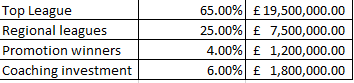
Division of revenue would depend on the total “income” pot (TV, Sponsorship etc) money obtained in each year or each multi-year deal.  A % of revenue should be ring-fenced to add to existing coaching and grass roots development.  At least £1,000,000 should be retained for the promotion playoff final winners. Using the recent £30,000,000 per season deal a recommended split would be as follows:

This would distribute the wealth as shown:

This is a significant increase in the distribution for teams in the regional leagues and less for the top leagues.  Which begs the question, why would the vote for it?  This is about addressing the balance of the game in the country to encourage the development of our own players.  With more money for the regional teams, who all become feeder teams for Scottish players, we allow these clubs to improve facilities and improve coaching levels.

Measures of success

  1. Fan attendance increases
  2. TV and digital coverage revenue increase
  3. Increased domestic success within European competition
  4. Qualification for a major international event within 8-12 years of implementation.

Update

Well it has been a few months since I wrote this and what has happened in the world of Scottish football. Celtic crash out of the champions league, Aberdeen and Kilmarnock are out of the Europa league and Ladbrooks confirm they will end sponsorship of the SPFL, opting not to extended a 5 year deal. Given the focus on gambling and the scrutiny these companies are under this probably wasn’t to much of a shock.

The big worry for everyone in Scottish football must be that the UK may be in Europe longer than our clubs this season. Good luck to Rangers who march on and Celtic who parachute into the Europe league. Let’s home for an extended run from the Old Firm this year… at least beyond the No Deal deadline!